H-4 EAD Processing Times and the DHS Automatic Extension Rule
H-4 EAD renewals face months-long processing delays with no automatic extension cushion.

Anyone quoting you a single processing time is doing you a disservice. Standalone I-765 filings under category (c)(26) are running between 6 and 15.5 months as of mid-2026. That long tail is not an outlier; it represents a real share of real applicants sitting in a real queue with no premium processing option and no automatic extension to cushion them. USCIS's own published estimates put initial applications at roughly 5 to 9 months and renewals at 3 to 7 months, depending on service center. Bundled filings average around 6 months and still offer a processing advantage, but the concurrent adjudication guarantee that once made bundling near-foolproof is gone.
Service center variation is real and worth knowing even if it offers no workaround. The Texas Service Center is currently the fastest. The Potomac Service Center is not. You cannot choose your service center, but you can stop being surprised when timelines diverge by months based on geography alone.
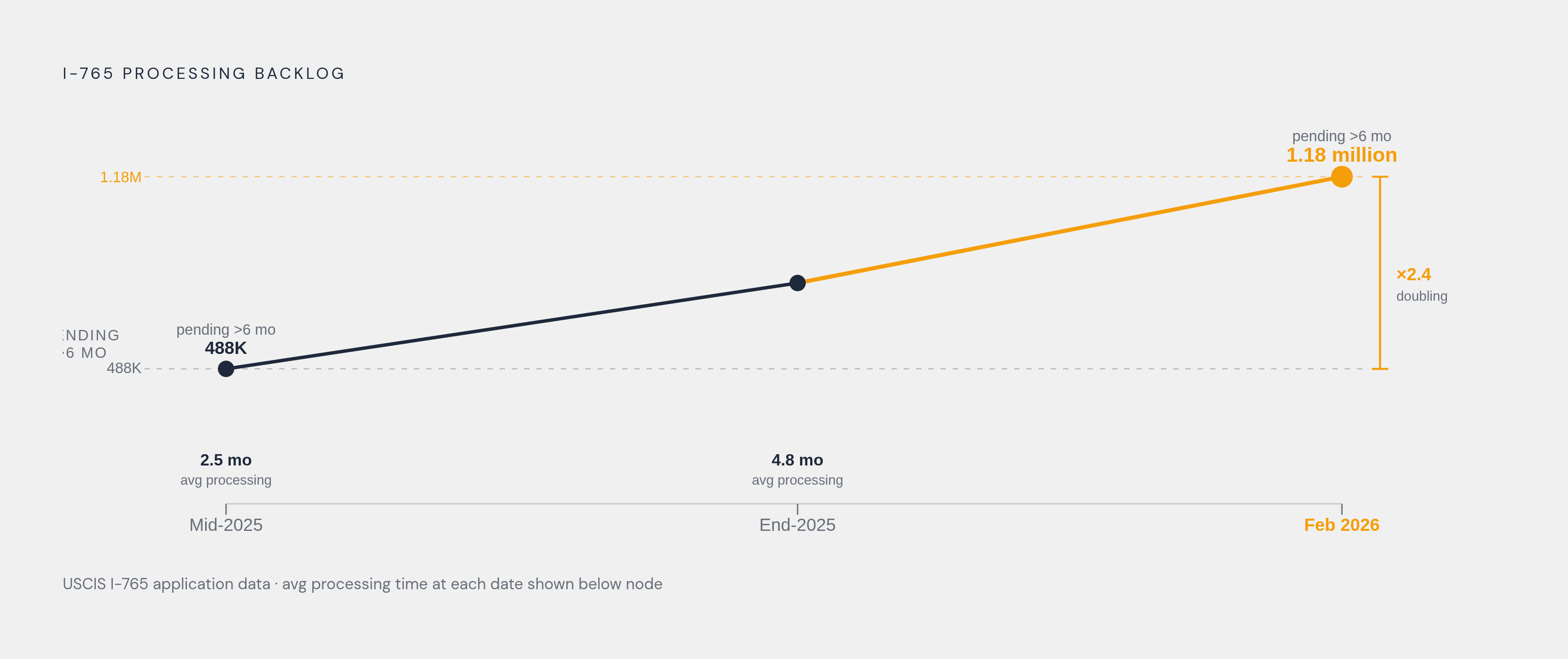
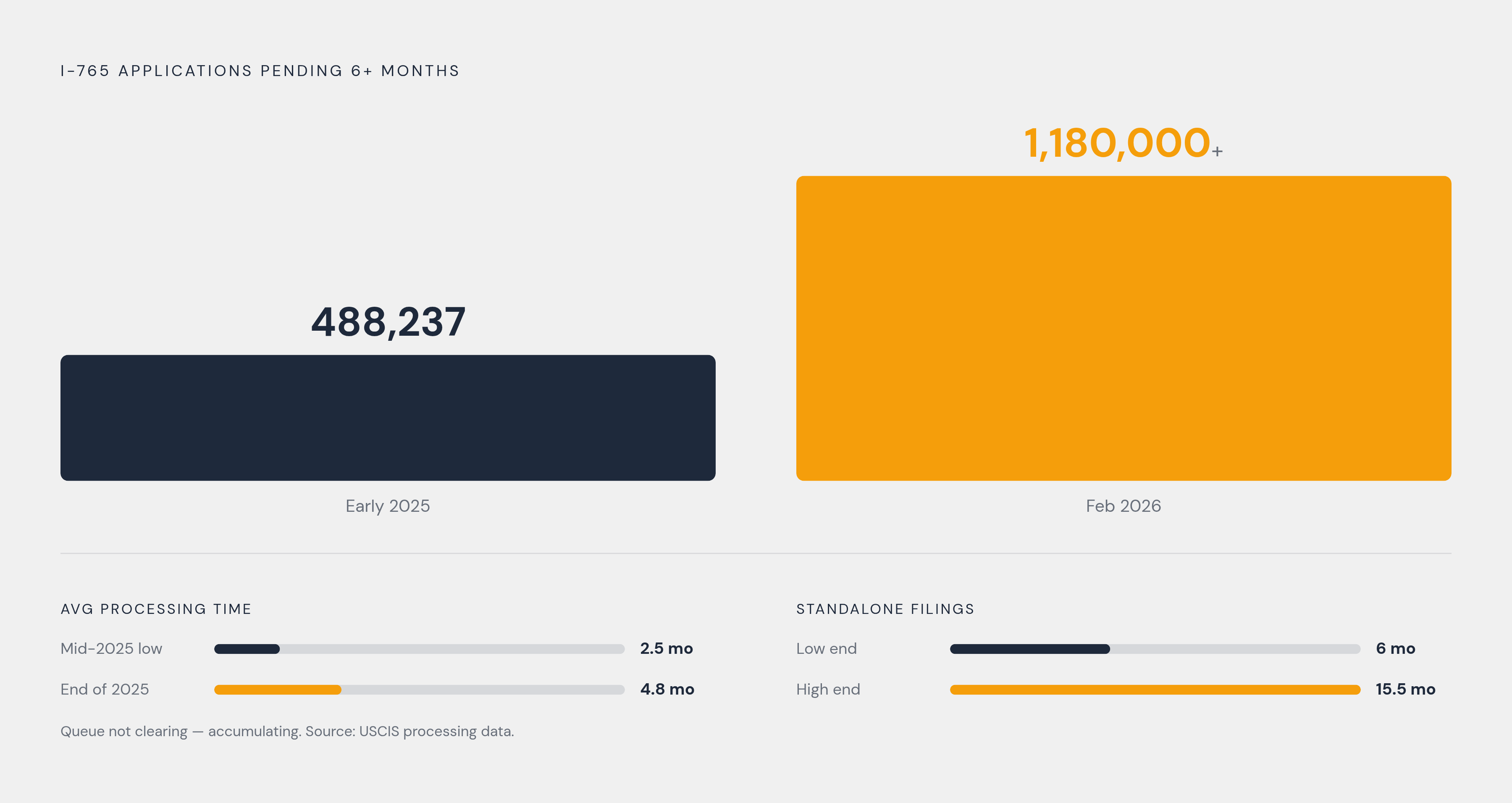
The backlog data is as follows: average I-765 processing hit a low of 2.5 months in mid-2025, then climbed to 4.8 months by year's end. By February 2026, nearly 1.18 million I-765 applications had been pending for more than six months, more than double the 488,237 sitting in that bucket a year earlier. H-4 EAD filings run roughly 22,000 to 23,000 receipts per quarter; in Q1 of fiscal year 2026 alone, USCIS received 20,121 applications with 35,667 cases still pending from prior periods. The queue is not clearing between quarters. It is accumulating.
There is one reassuring number buried in all of this: approval rates, once cases actually reach adjudication, are strong. Across fiscal year 2025, they ranged from 96.4% to 97.7%, with 81,209 approvals against 2,359 denials. These figures are drawn from USCIS's published adjudication statistics. The wait is the problem. The outcome, when it finally arrives, is usually favorable.
Premium processing is not available for the H-4 EAD itself. Acceleration options are narrow: bundle with a premium-processed H-1B extension, or qualify for a USCIS expedite. Expedite criteria are tight, requiring documented severe financial loss, a humanitarian emergency, or a clear USCIS error. Meeting one of those criteria is necessary but not sufficient; USCIS retains discretion in granting expedite requests, and approval rates for such requests are low.
What the Edakunni Settlement Actually Did, and Why January 2025 Marked a Significant Change
The Edakunni v. Mayorkas class action settlement, effective January 19, 2023, required USCIS to adjudicate bundled H-4 and H-4 EAD applications concurrently with the H-1B principal's petition. In practice, this produced processing times as short as two to three weeks for bundled filings. It was, by a significant margin, the most favorable processing environment the H-4 EAD program had seen under that settlement, and many families built their planning around it as though it were permanent.
The settlement expired January 18, 2025.
USCIS is no longer obligated to process bundled cases together. Some service centers have continued the practice voluntarily; others process separately. The outcome is now functionally unpredictable. Couples who had grown accustomed to concurrent approval within weeks can no longer count on that. Filing with the H-1B extension still offers an average processing advantage, and it remains the better strategy. It no longer guarantees anything about timing.
This expiration deserves its own paragraph, not because it is dramatic, but because it is routinely collapsed into the October 2025 rule story when it is actually a separate event that materialized first. The Edakunni expiration is its own layer of planning risk. The October rule is a different one on top of it.
The October 30, 2025 Rule That Eliminated Automatic Extensions, and the Math That Makes It Disruptive
Automatic extensions for EAD renewal applicants existed in some form since January 2017. The mechanism was sensible: a timely filed renewal let the holder keep working past the card's printed expiration date while the renewal was pending. As the backlog worsened, the extension window grew, from 180 days to 540 days, eventually codified into federal regulation in December 2024.
Ten months later, it was gone.
The October 30, 2025 interim final rule, published at 90 FR 48805 under Federal Register docket USCIS-2025-0271, eliminated automatic extensions for renewal applications filed on or after that date. The rule went into effect immediately, with a 30-day comment period running alongside enforcement rather than before it. DHS cited national security executive orders, EO 14159 and EO 14161, and a June 2025 incident in Boulder as its stated rationale.
The operational consequence is unambiguous. When a current EAD card expires, work authorization ends, regardless of whether a renewal is pending. A receipt notice is no longer work authorization documentation for post-October 30, 2025 filers. You need a valid, unexpired physical card to keep working.
Grandfathered filers, those whose applications were received by USCIS before October 30, 2025, retain the expired card plus receipt notice combination, up to 540 days of continued authorization. TPS holders have a separate statutory exception the rule does not touch.
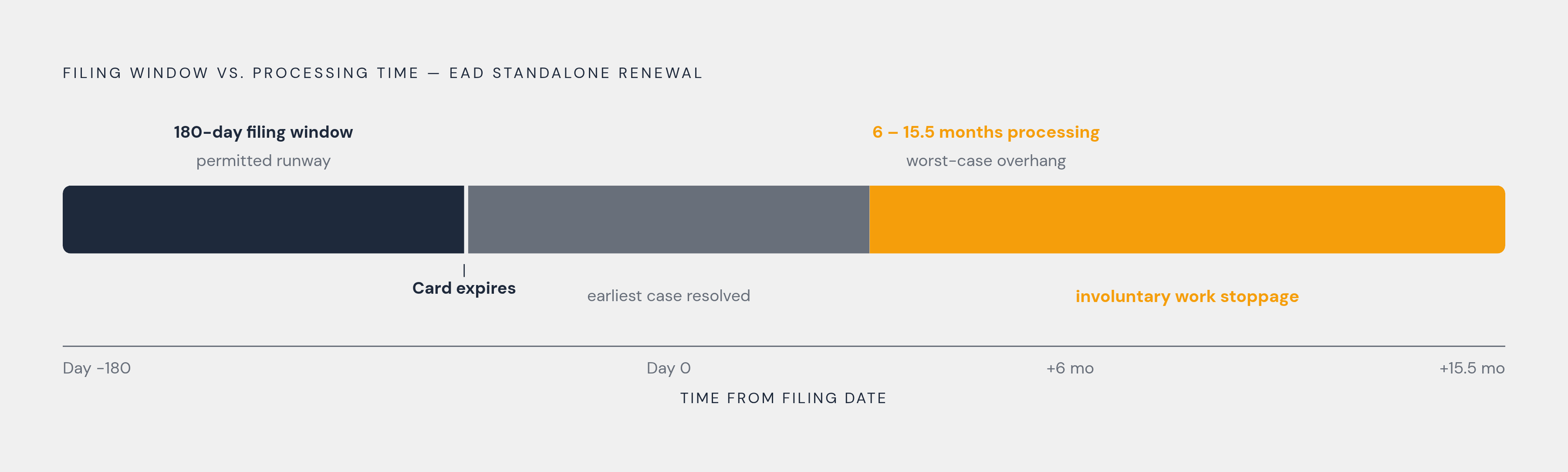
Here is where the math becomes consequential: USCIS recommends filing no more than 180 days before card expiration. Standalone renewals are taking 6 to 15.5 months. A filer who submits exactly at the 180-day mark, following USCIS's own published guidance, will face months of involuntary work stoppage before approval arrives. No planning error by the applicant produced that outcome. The system produced it.
For employers, the I-9 compliance dimension is equally concrete. Receipt notices no longer anchor work authorization for post-cutoff filers. Companies with H-4 EAD holders on staff should be auditing expiration dates now, case by case, before a card lapses and the conversation becomes retroactive.
The Lawsuit Challenging the Rule, and Why a Narrow Outcome Is the Most Likely Result
In January 2026, seven spouses of H-1B visa holders filed suit in the Central District of California. The case, Doe v. U.S. Department of Homeland Security, seeks nationwide vacatur of the rule under the Administrative Procedure Act. The core arguments are procedural and substantive: the rule was promulgated without the notice-and-comment process the APA requires, and the justifications cited do not meet the legal threshold for the immediate-effect exemption the agency invoked.
These are not frivolous arguments. The APA's procedural requirements exist precisely to prevent agencies from issuing consequential rules without public input, and the immediate-effect exemption is supposed to be narrow.
That said, the realistic scope of any favorable outcome is modest. The plaintiffs' own counsel has indicated the court was not positioning to vacate the rule nationwide. Any win is more likely to benefit the seven named plaintiffs and no one else. USCIS has separately indicated it plans to issue a final rule through a formal notice-and-comment process, which will modify, preserve, or replace the interim final rule depending on what that process produces.
One piece of context relevant to the case: as of September 30, 2025, more than 395,000 EAD renewal applications had been pending for over 180 days. The processing backlog the automatic extension was designed to address has not improved; it has deepened.
For planning purposes, the rule is in effect. Relief for non-named filers is legally uncertain. Planning around a favorable court outcome that does not materialize is imprudent, and a work authorization gap is too consequential to treat as a hedge.
One separate note worth flagging: Save Jobs USA v. DHS, the challenge to the H-4 EAD program's fundamental legal authority, was denied certiorari by the Supreme Court on October 14, 2025. The program is legally settled. H-4 spouses are authorized by law to hold work permits. The current fight is about the automatic extension mechanism, not about whether the program should exist.
When to File, Which Form to Use, and the Avoidable Mistakes That Add Months to an Already Long Wait
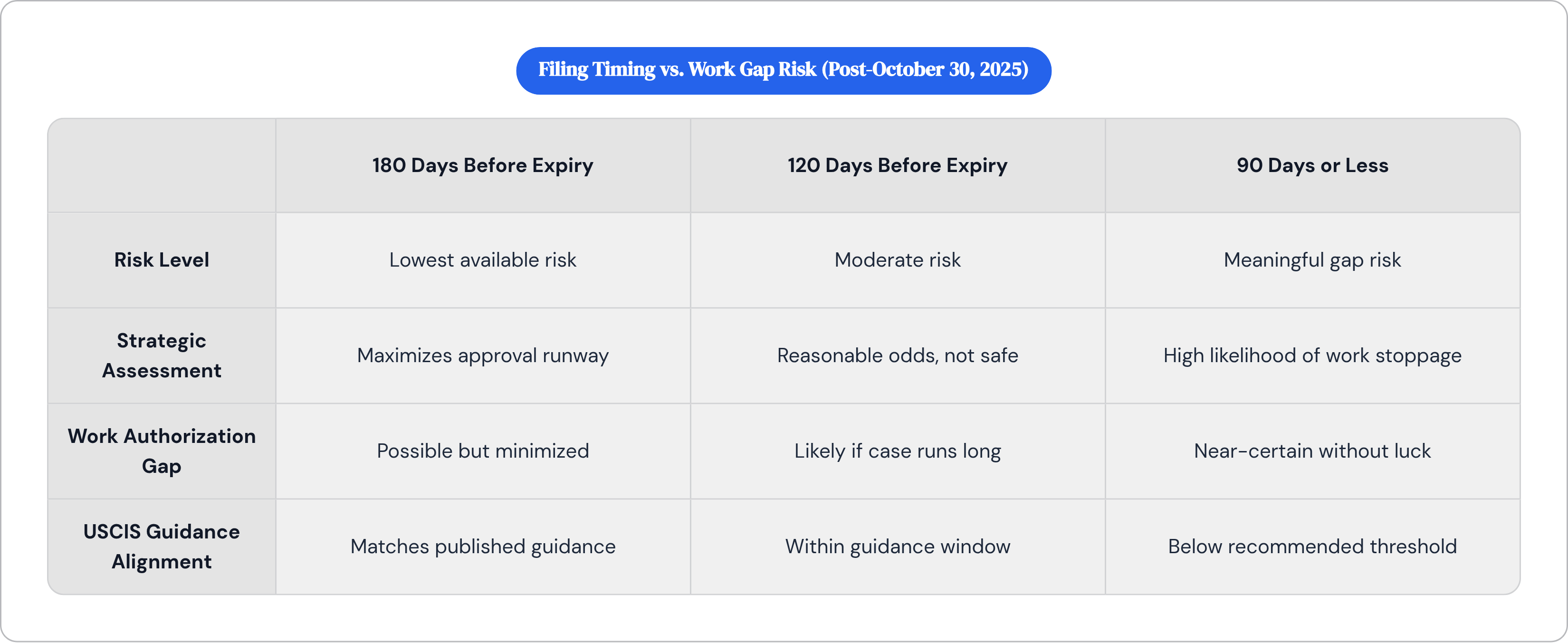
The 180-day filing window is now a hard strategic boundary. Filing at exactly 180 days before card expiration maximizes the runway for approval before the card lapses. Filing at 120 days still gives reasonable odds given current average processing times, though cases can run to 12 months and beyond. Filing at 90 days or less carries meaningful risk of a work authorization gap.
Form version is an operational detail that matters more than it should. The current I-765 edition is dated 08/21/25 and became required starting March 5, 2026. Submitting an outdated edition is a common, entirely avoidable source of RFEs and delay. Verify the edition before filing; USCIS posts the current accepted version on the I-765 page.
Category (c)(26) is paper-only. No online filing option exists. The $520 filing fee applies.
The most common RFE trigger beyond form edition issues: missing certified translations of supporting documents not in English. The requirement is not discretionary, and it catches applicants who filed before under more lenient adjudication and assume prior practice still governs. It does not.
For applicants with consular components, the State Department expanded social media screening requirements for H-1B and H-4 visa applicants at consular posts, effective December 15, 2025. This affects initial visa issuance timelines for those applying abroad. It does not affect domestic I-765 filings directly, but it compounds the overall timeline picture for anyone needing a fresh visa stamp.
Bundling with the H-1B extension remains the better default strategy for the processing time advantage, even without Edakunni's concurrent adjudication guarantee.
If an application has been pending beyond USCIS's published processing time for I-765 category (c)(26), file a case inquiry through the USCIS online account. This is a defined procedural step. Calling the contact center before the published processing time has elapsed is generally unproductive; the inquiry mechanism is the right tool once that benchmark is crossed.
The most structural point, and the one most often treated as a footnote: the H-4 EAD is downstream of the principal's immigration trajectory. A shared, visible calendar tracking the H-1B principal's I-140 status, AC21 eligibility window, and H-1B extension dates alongside the EAD expiration and renewal timeline is not optional housekeeping. A gap in the principal's status creates a gap in the H-4 holder's eligibility. A lapse in the H-4 itself terminates work authorization regardless of what the I-140 says. These are not parallel tracks that can be managed independently; they interact, and when they interact badly, the path back is not always linear or fast.