Immigration Management Software for HR Teams

If you are still managing immigration compliance with a spreadsheet and a shared drive folder called "I-9s FINAL v3," this article is for you. Enforcement pressure has transformed immigration compliance from a periodic legal task into a continuous operational function, and the software market has followed. Understanding what these tools actually do, and how to choose one, is the practical work HR teams need to do now, not after an audit notice arrives.
The compliance environment that made spreadsheets untenable
Immigration compliance used to be episodic. A hire triggered a call to outside counsel, counsel handled the petition, HR filed the receipt notice somewhere, and everyone moved on until the renewal came up, usually surfaced by whoever happened to remember it.
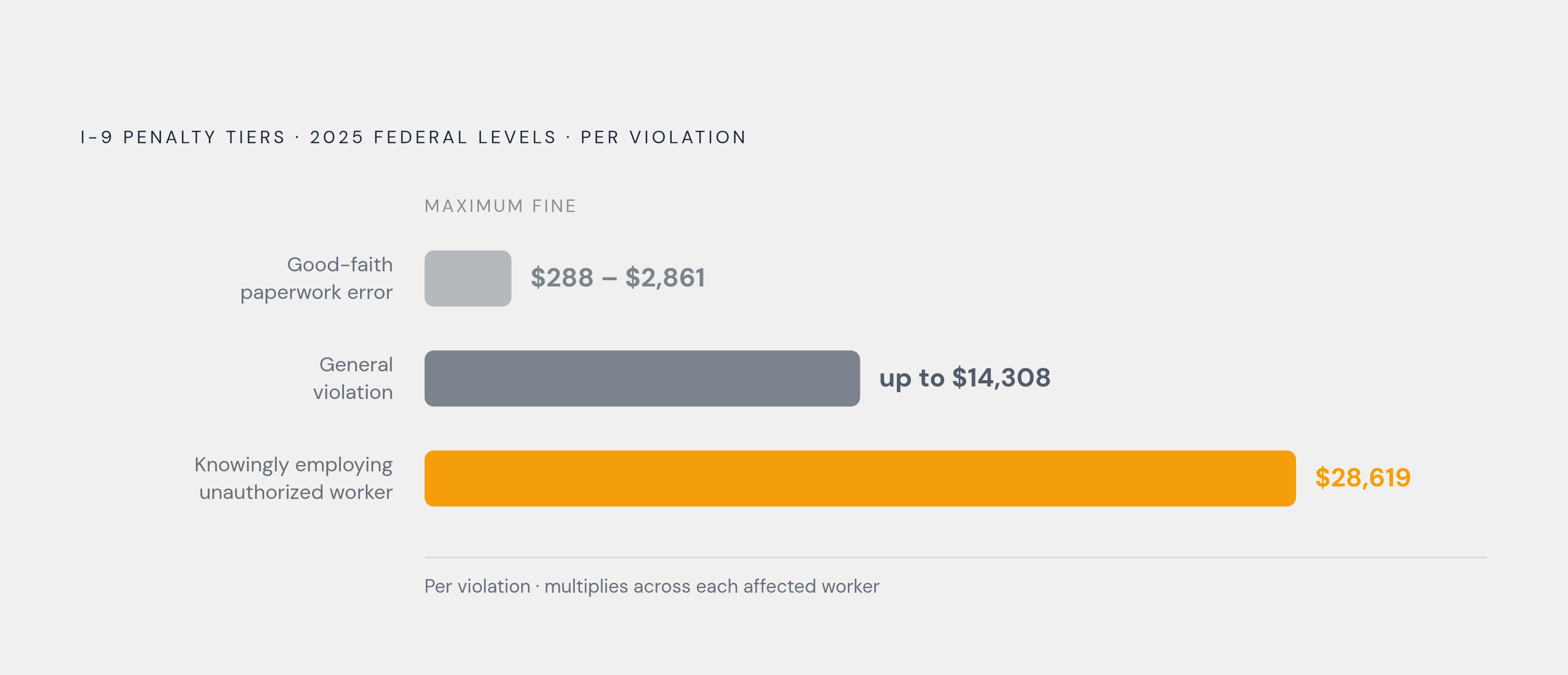
That model broke down as enforcement intensity and regulatory volume both increased simultaneously. In the United States, ICE delivered more than 5,200 I-9 audit notices in a two-phase nationwide operation as of February 2025. DHS raised I-9 violation penalties to up to $28,619 per violation for knowingly employing unauthorized workers, also in January 2025. Even good-faith paperwork errors carry per-violation fines ranging from $288 to $2,861. These are not abstract risks; they are calculable costs attached to specific document failures.
The enforcement trend is not exclusively American. The EU's Entry/Exit System reached full deployment in April 2026, adding a new compliance surface for employers managing cross-border European workforces. Restrictive policy tightening is occurring across multiple jurisdictions at roughly the same time, which means any employer with a distributed or hybrid workforce is managing a compliance perimeter that is measurably larger than it was five years ago.
The result: immigration compliance is no longer a legal team's annual review. It is an ongoing tracking problem, an audit-readiness problem, and a process discipline problem, all at once. Software exists because the alternative has become genuinely untenable.
What manual immigration tracking actually looks like — and where it breaks down
The typical manual setup is not one system; it is four or five loosely coupled ones. Visa expiry dates live in a spreadsheet someone updates inconsistently. I-9 documents occupy a shared drive with a folder structure that made sense to whoever built it three HR directors ago. Petition deadlines are calendar reminders attached to someone's personal work calendar. Communications with outside counsel run through email threads with subject lines like "Re: Re: Re: H-1B renewal."
This arrangement fails in predictable ways.
Deadline drift is the most common failure mode. Without a centralized alert system, expiring work authorization gets caught only when someone remembers to check, or when an employee flags it because their own status is at stake. Document gaps are equally endemic: I-9s stored across paper and digital formats accumulate version errors, and version errors carry real consequences. USCIS required a new Form I-129 as of January 17, 2025, with no grace period for older versions. If your process depends on a paralegal remembering to update a template, you are one oversight away from a filing on a superseded form.
Data re-entry compounds every other problem. HR enters employee information for payroll, then again for petition paperwork, then again when briefing counsel. Each handoff is an independent error opportunity, and errors in immigration paperwork are not self-correcting.
Audit exposure is the final, most consequential failure. Manual processes produce no audit trail. When an ICE notice arrives, reconstructing compliant documentation for every affected employee from a shared drive and an email archive is not a compliance exercise; it is an archaeological expedition, conducted under time pressure, with real financial penalties attached to whatever you cannot find.
The H-1B modernization rule finalized in January 2025 added another layer of complexity: expanded USCIS site visit authority, including to third-party placements, with the stipulation that a site's refusal of access can result in petition denial or revocation. Manual tracking cannot reliably prepare an organization for that scenario. The information required to respond credibly to a site visit — specifically, current petition status, worksite details, and supporting documentation — needs to be immediately accessible, not scattered across four systems like puzzle pieces with no picture on the box.
Envoy Global's 2025 survey of more than 500 HR and global mobility professionals identified data scattered across multiple systems as a top challenge, with teams specifically wanting better case processing, self-service reporting, task automation, and HRIS integration. The underlying issue, as anyone who has managed immigration compliance manually will confirm, is not effort. It is that the information lives in too many places for any one person to hold reliably.
What immigration management software actually does: the core functional modules
The category label is vague enough that vendors can claim membership without delivering the same thing. Here is what a serious platform actually contains.
I-9 and E-Verify automation
Centralized I-9 completion and storage, with automated re-verification alerts before work authorization expires, is the foundational layer. E-Verify integration should be built into the workflow rather than operating as a separate manual step. The value is not just convenience; it is that the system closes the gap between document collection and verification, and it flags upcoming expirations before they become violations.
Case management and deadline tracking
Every petition stage, from intake through adjudication, is tracked with task assignments and deadline alerts. HR can see status across all open cases from a dashboard without calling or emailing counsel to ask. This eliminates one of the most time-consuming and error-prone aspects of manual management: the status-check loop.
Document management
Optical character recognition pulls data from uploaded documents, reducing manual re-keying. Smart templates auto-populate USCIS forms using existing employee data. Version control and audit trails ensure that the forms being used are current and that every action is recorded. E-signature integration handles authorization workflows without requiring physical paperwork.
Public Access File management
LCA-related documentation for H-1B compliance is a common gap in manual processes. PAF management keeps this documentation organized and inspection-ready. It is unglamorous functionality, but it is exactly the kind of thing that surfaces as a liability during an audit.
Employee self-service portal
Employees can submit their own documents, track case milestones, and receive USCIS status updates without routing every query through HR. This is genuinely valuable: it reduces HR's role as a message relay between employees and counsel, which is a role HR should not be playing in the first place.
Reporting and analytics
Real-time case status across the organization supports both internal reporting and coordination with outside counsel. Leadership can see the organization's compliance exposure without commissioning a manual audit of the shared drive.
HRIS and HCM integration
This is the connective tissue that makes everything else functional. Without it, the immigration platform is just another silo. With it, a job title change in the core HR system automatically surfaces in the immigration platform as a potential visa status issue, which is the kind of automated catch that manual processes simply cannot replicate.
How to think about the software-versus-service distinction before evaluating any vendor
Before comparing features, resolve one structural question: do you want software that your team or counsel operates, or a platform where attorney representation is bundled into the service?
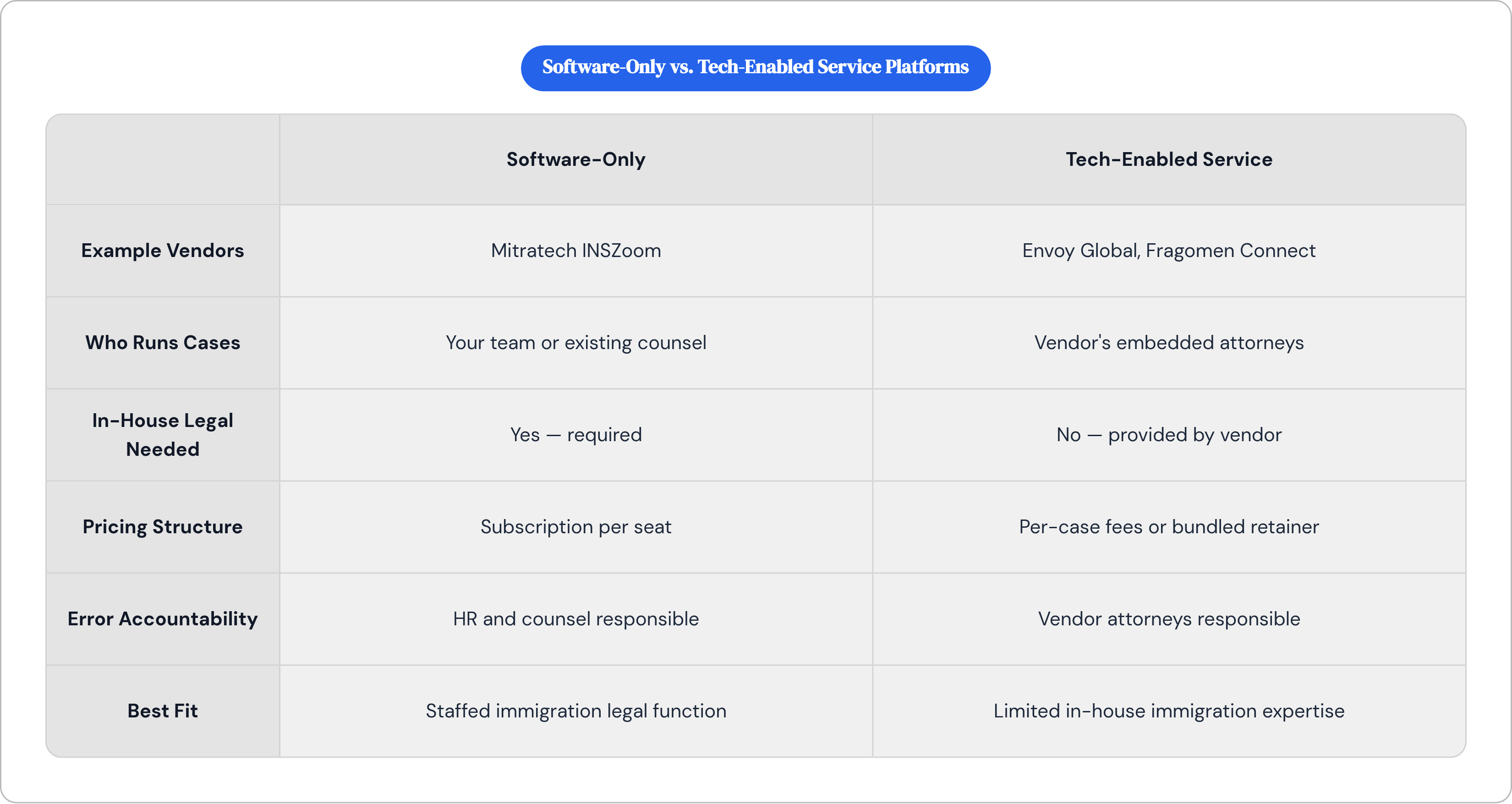
The market divides cleanly along this line. Software-only tools, Mitratech INSZoom being the clearest example, give HR or in-house counsel a platform to run cases; attorneys are your own or separately engaged. Tech-enabled service platforms, Envoy Global and Fragomen Connect being the established examples, bundle software and attorney representation; the vendor manages cases, and HR manages the relationship and reporting. Newer entrants like Gale Visa are positioning between these camps, integrating legal support with a modern, AI-driven platform in ways that blur the category boundary.
This distinction matters before anything else because it determines three things: staffing model (software-only tools require in-house legal capacity or an existing attorney relationship), pricing structure (subscription per seat versus per-case service fees versus bundled retainer), and accountability (who is responsible when a petition has an error or a deadline is missed).
Neither model is inherently superior. The right answer depends on the HR team's in-house legal depth, case volume, and how much operational control versus external support the organization wants. An enterprise with a staffed immigration legal function may find a software-only tool provides exactly the infrastructure they need without paying for services they already have. An employer without in-house immigration expertise, running meaningful case volume, will likely find the tech-enabled service model more defensible.
Cloud deployment now dominates the market, capturing nearly three-quarters of market share in 2025, so the on-premises versus cloud question is largely settled. The software-versus-service distinction is the more consequential choice, and it should precede any feature evaluation.
How the major platforms compare on what HR teams actually care about
No single platform leads on every dimension. The comparison is genuinely useful only when filtered through the specific parameters of the organization evaluating it.
Envoy Global is an enterprise-scale, tech-enabled service platform with integrations across Workday, ADP, SAP SuccessFactors, Greenhouse, and UltiPro. It handles both inbound immigration and outbound global mobility, and is positioning generative AI capabilities as a forthcoming differentiator. It is built for large employers running high-volume, multi-country programs, and its feature set reflects that scope.
Mitratech INSZoom, now consolidated following acquisition, maintains a comprehensive form library covering more than 90 countries, updated within 48 hours of official regulatory release. It scores well on enterprise readiness and scalability in independent assessments, though its interface is widely described as dated. Average user ratings on G2 sit at 3.5 out of 5 as of 2026, and implementation typically runs three to four weeks. It is best suited for corporate legal departments and law firms that need broad country coverage and can absorb a steeper learning curve.
LawLogix, now under Hyland, has strong I-9 management expertise, deep audit trail capabilities, and solid HR system integrations. It is built for corporate legal departments managing compliance alongside case volume and is particularly well regarded for compliance tracking depth.
Fragomen Connect, incorporating SimpleCitizen technology, is a law firm-origin platform that brings deep domain expertise and proprietary case management to a tech-enabled service model. It is suited for employers who want firm-grade legal oversight structurally embedded in the software relationship, not just available on request.
Gale Visa, founded in 2024 and a Y Combinator Winter 2025 participant, is focused on U.S. employment-based visas with an AI-driven approach and a modern UX. Its HRIS monitoring for job changes that affect visa status is a notable architectural choice. It is worth watching for mid-market employers who find legacy platforms cumbersome, though its track record is, by definition, short.
Imagility targets attorneys, HR teams, and petitioners in a single platform, with emphasis on AI-assisted petition, document, and RFE management. eimmigration by Cerenade offers more than 300 forms and 120-plus case process templates, targeting both law firms and corporate in-house teams, with a notable 50% nonprofit discount and a consistently current form library.
The pattern that emerges from any honest comparison: the right choice is determined by case volume, the presence or absence of in-house legal capacity, the existing HRIS ecosystem, and geographic program scope, not by which platform has the most polished sales deck.
What to evaluate beyond features when selecting a platform
Feature lists are the easy part. The harder evaluation is operational and contractual.
HRIS and ATS integration depth deserves scrutiny beyond whether integration exists. The relevant question is whether it is real-time and bidirectional. A job title change in Workday that does not surface automatically in the immigration platform is a compliance gap waiting to materialize. Ask every vendor which systems they connect to natively versus through middleware, and what the latency is.
Data security standards are non-negotiable. I-9 and immigration files contain passport numbers, visa documents, and citizenship data. Bank-level encryption and role-based access controls are baseline expectations, not competitive differentiators. Treat any vendor who presents these as selling points with mild suspicion.
Scalability cuts both ways. Corporate buyers represent the largest segment of the current market, but SME growth is accelerating and is projected to outpace enterprise growth through the early 2030s. SMEs in particular should pressure-test whether an enterprise-grade platform is operationally appropriate for their case volume or whether they are paying for infrastructure they will never use.
Implementation reality is routinely undersold. INSZoom's three-to-four-week implementation is a useful reference point; ask every other vendor for a comparable estimate and what HR is required to provide during setup. A vendor who cannot answer this question concretely has likely not thought carefully about your onboarding experience.
Form currency and regulatory update cadence is a compliance-critical variable. USCIS issued a mandatory new Form I-129 in January 2025 with no grace period. How quickly your vendor updates its form library is not a minor operational detail; it is a direct determinant of your compliance exposure. INSZoom's 48-hour update standard is a concrete benchmark; ask others how they compare and what their process is.
Support model in adversarial situations matters more than any other support consideration. When an RFE arrives or ICE sends an audit notice, what does the vendor's response look like? Software-only tools require HR to mobilize counsel independently. Service platform vendors have attorneys embedded in the response workflow. Know which situation you are in before you need to test it.
Total cost of ownership requires modeling both scenarios. Cloud-based platforms carry meaningfully lower five-year TCO than on-premises alternatives, according to available market analyses. But per-case service fees in bundled models can grow significantly with case volume. Model the cost at your actual projected case volume, not at the volume that makes the vendor's pricing look favorable.
Where immigration software fits within a broader HR compliance posture
Immigration software does not replace legal judgment. It makes information reliably available so that HR and counsel can make better decisions faster. The audit trail is only as clean as the data entered into it; a well-implemented system with careless data hygiene is not meaningfully better than a well-organized spreadsheet.
The broader context is worth naming plainly. The H-1B registration fee increased from $10 to $215 per beneficiary for FY2026. That is a small number in absolute terms but a significant directional signal: the administrative cost of employing international talent is rising across fees, documentation requirements, and enforcement risk simultaneously, and there is no visible reason to expect that trend to reverse. Think of it as a tide that keeps coming in — the organizations still building sandcastle defenses out of spreadsheets are going to get wet.
Against that backdrop, the immigration software market's trajectory from roughly $3.14 billion in 2025 to a projected $6.62 billion by 2031 at a compound annual growth rate of approximately 13.47% reflects genuine demand. Employers are investing in process infrastructure because the cost of not doing so has become concrete and calculable, not because the software is aspirationally attractive.
A well-implemented system delivers three things that matter. First, audit readiness as a default state rather than a crisis response. Second, visibility that allows HR to report accurately to leadership on workforce composition and compliance exposure. Third, a documented process that protects the organization if an individual makes an error, because the system's record demonstrates the intent to comply.
The practical test is simple: if ICE sent an I-9 audit notice today, how long would it take to produce a clean, complete file for every affected employee? If the honest answer involves opening a shared drive, searching through email, and calling someone who might remember where things were filed, the answer to whether current tooling is adequate is also honest, and it is no.