USCIS Form Error Rates and How to Avoid Rejections
Missing signatures now trigger permanent denials instead of simple rejections under new 2026 rules.

These two words are not interchangeable, and conflating them is one of the more consequential misconceptions in immigration practice. Most applicants treat them as synonyms. They are not, and the gap between them has ended careers in the United States.
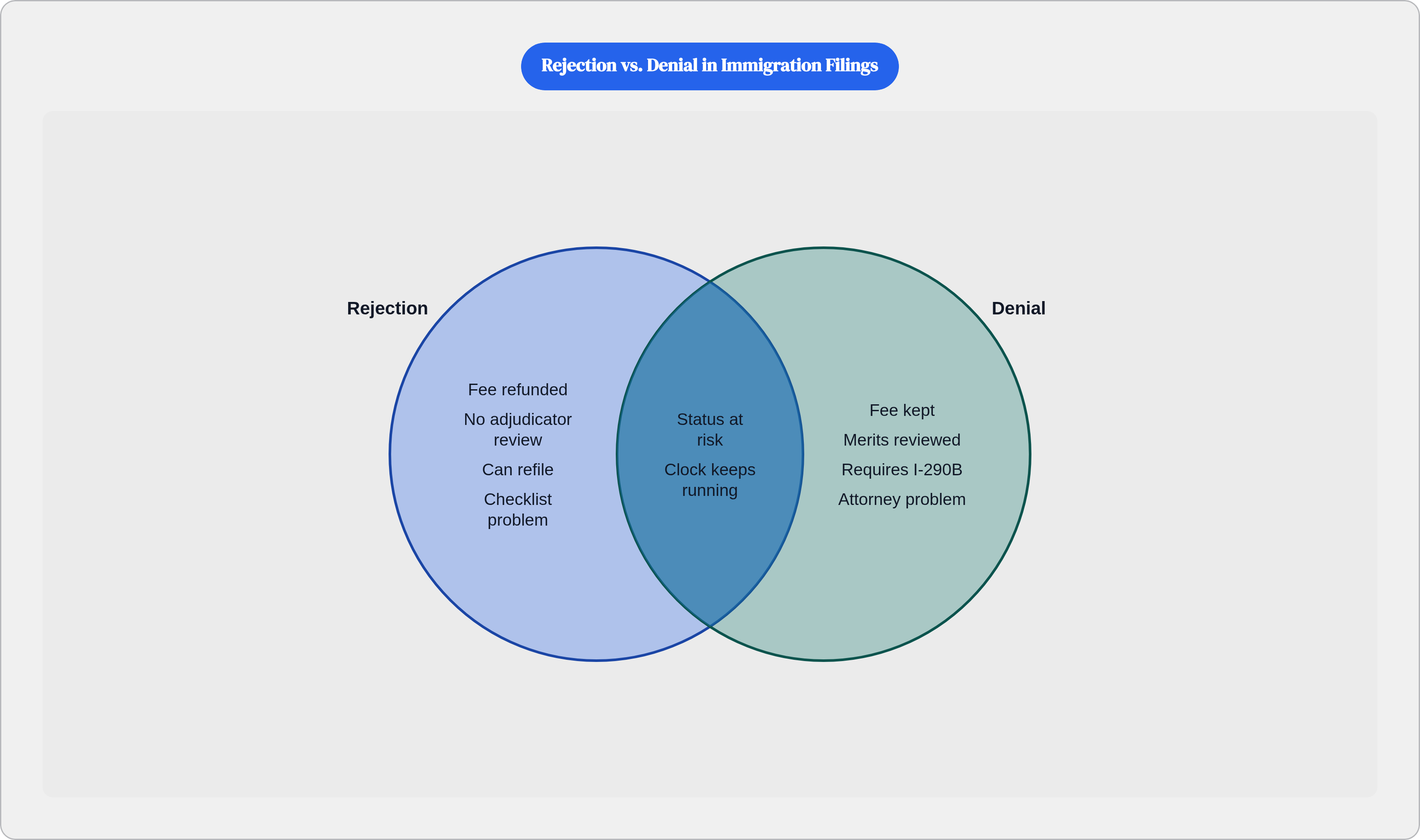
A rejection is administrative. The filing comes back, the fee is generally refunded, and USCIS treats the petition as though it never arrived. No adjudicator touched it. No eligibility call was made. The petitioner is theoretically free to fix the error and refile — except that the clock has been running the entire time, and the queue they are refiling into is longer than the one they left. Think of it like getting bumped from a flight: you didn't lose your ticket, but you lost your seat, and the next plane is fuller.
A denial is a different animal entirely. The filing was accepted, the fee was cashed, an adjudicator reviewed the merits, and USCIS ruled against it. Challenging that requires Form I-290B or a full refile with a new fee. The procedural and financial cost is substantially higher, and the record now reflects an adverse determination.
The most dangerous version of this confusion plays out with the I-485. A pending I-485 can anchor an international professional's status during a job transition or an OPT gap. But that protection belongs to a pending filing, not a rejected one. A rejection erases the anchor. The protection never existed. For someone who reorganized their professional life around that pending application, the word "rejected" versus "denied" is not a semantic nuance. It is the difference between being in status and being out of it. And yes, USCIS has been documented to reject valid filings due to scanning errors, fee misidentification, and form version confusion. When that happens, the burden of proving the agency wrong still falls entirely on the petitioner.
The Signature Rule That Changed the Calculus: Rejections Can Now Become Permanent Denials
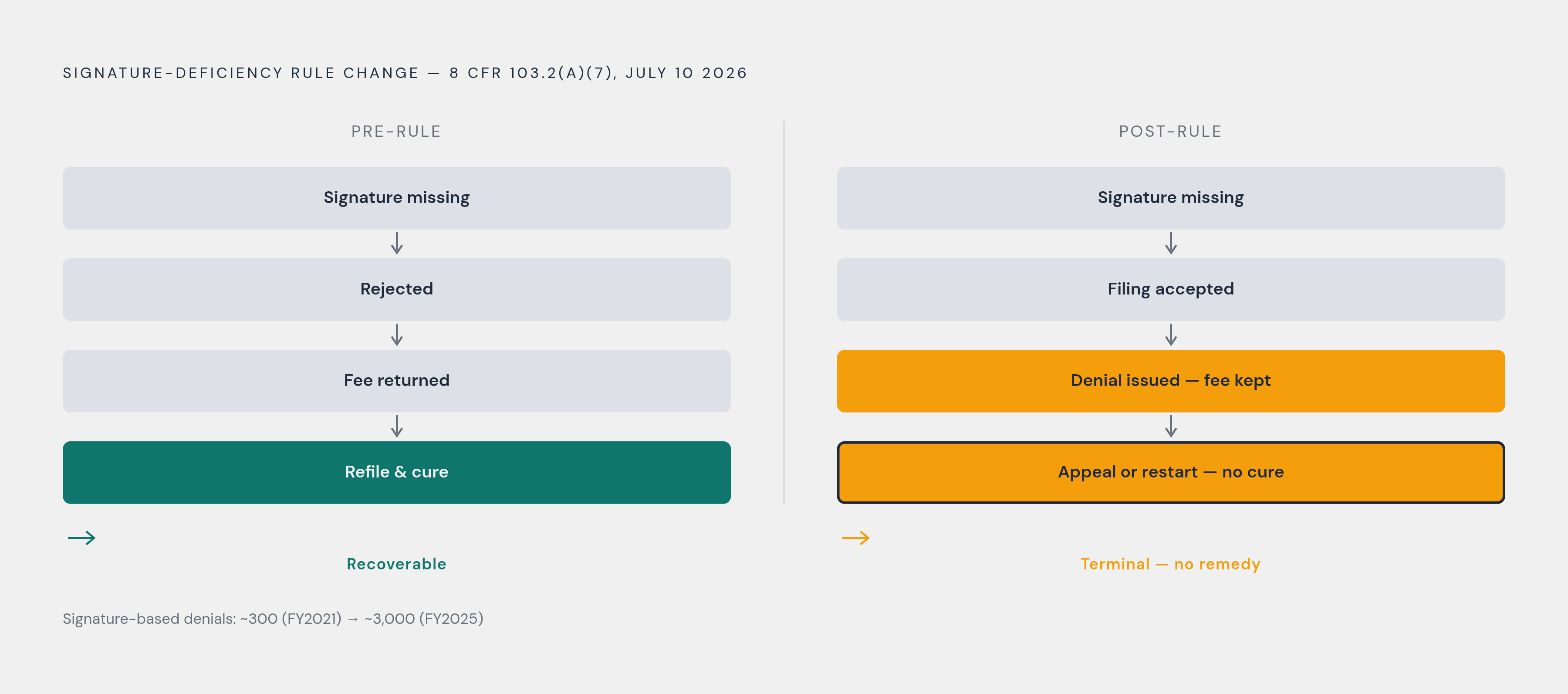
For most of immigration history, a missing signature was survivable. USCIS returned the filing, refunded the fee, the petitioner signed the form, and everyone moved on. Inconvenient, occasionally stressful, but recoverable.
That changed. Effective July 10, 2026, DHS published an interim final rule amending 8 CFR 103.2(a)(7), giving USCIS the authority to accept a defective filing, keep the fee, and issue an outright denial when a signature deficiency surfaces during adjudication. The old sequence was: signature missing, rejection, fee returned, refile. The new sequence is: signature missing, filing accepted, denial issued, fee kept, now appeal or start over. No cure mechanism. USCIS explicitly rejected the option of allowing petitioners to substitute a corrected signature mid-adjudication, on the grounds that deficient submissions would otherwise occupy cap slots and hold priority dates while corrections were processed. Whether you find that reasoning persuasive or maddening, it is now binding.
The volume that drove this rule is worth sitting with. Signature-based denials climbed from 300 in FY2021 to nearly 3,000 in FY2025. USCIS's Administrative Appeals Office had already adjudicated 758 appeals of signature-related denials before the rule formalized anything. That is not a rounding error. Those are real cases, real attorneys, real clients who lost fees and sometimes status over a missing pen stroke.
What the rule requires: a handwritten, wet-ink original signature. Scanned or faxed copies of a form that bore a valid wet-ink signature remain acceptable, because the original met the standard before copying occurred. What is not acceptable: a digitally inserted signature, a copy-pasted signature, or any reproduction that substitutes for the act of signing.
For a professional on OPT or mid-H-1B transfer, this rule transforms a clerical slip into something with the practical consequences of a substantive denial. The line between a setback and a status crisis is now, literally, whether someone picked up a pen.
How Rejection Rates Vary by Form Type, and What the Numbers Reveal About Where the Real Risk Concentrates
Not all petitions carry equal procedural risk. The form you are filing shapes the exposure you face, and the numbers reveal where that exposure actually concentrates.
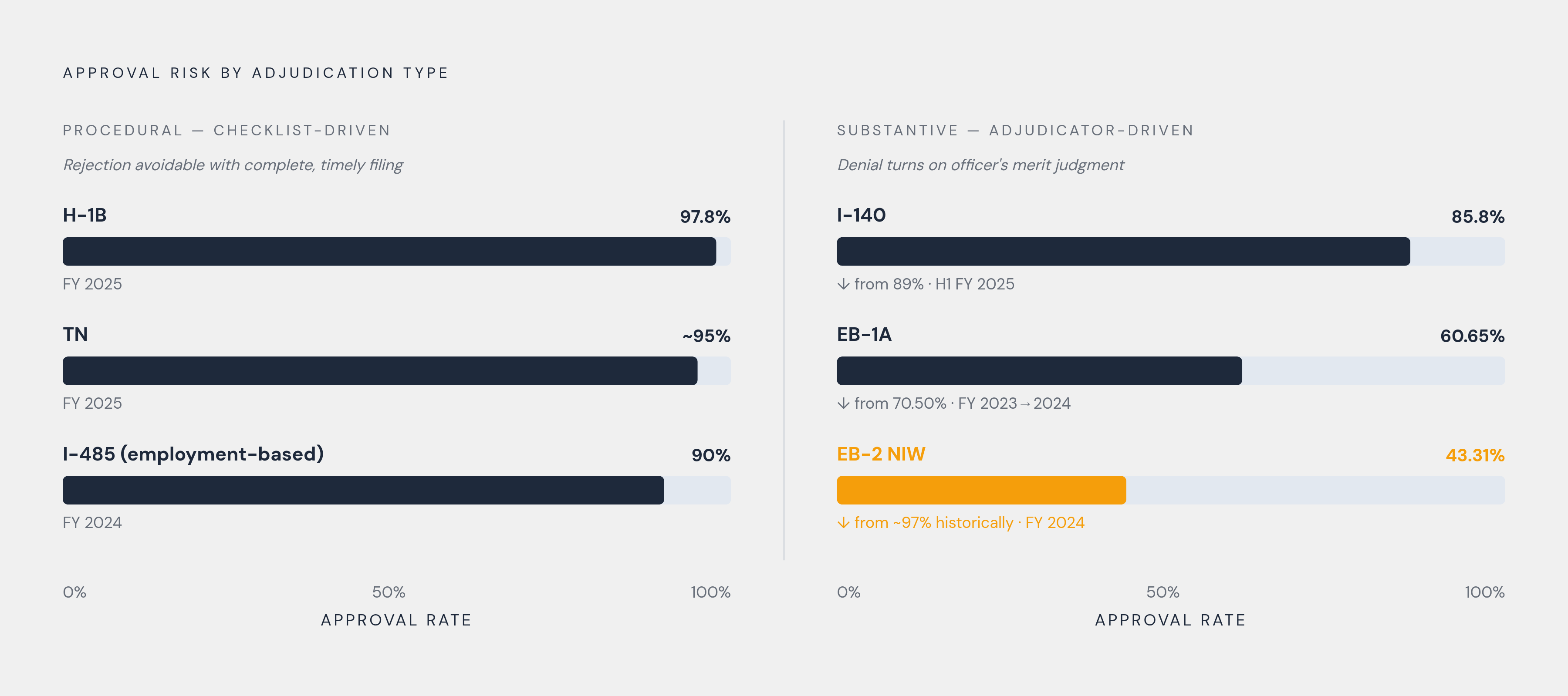
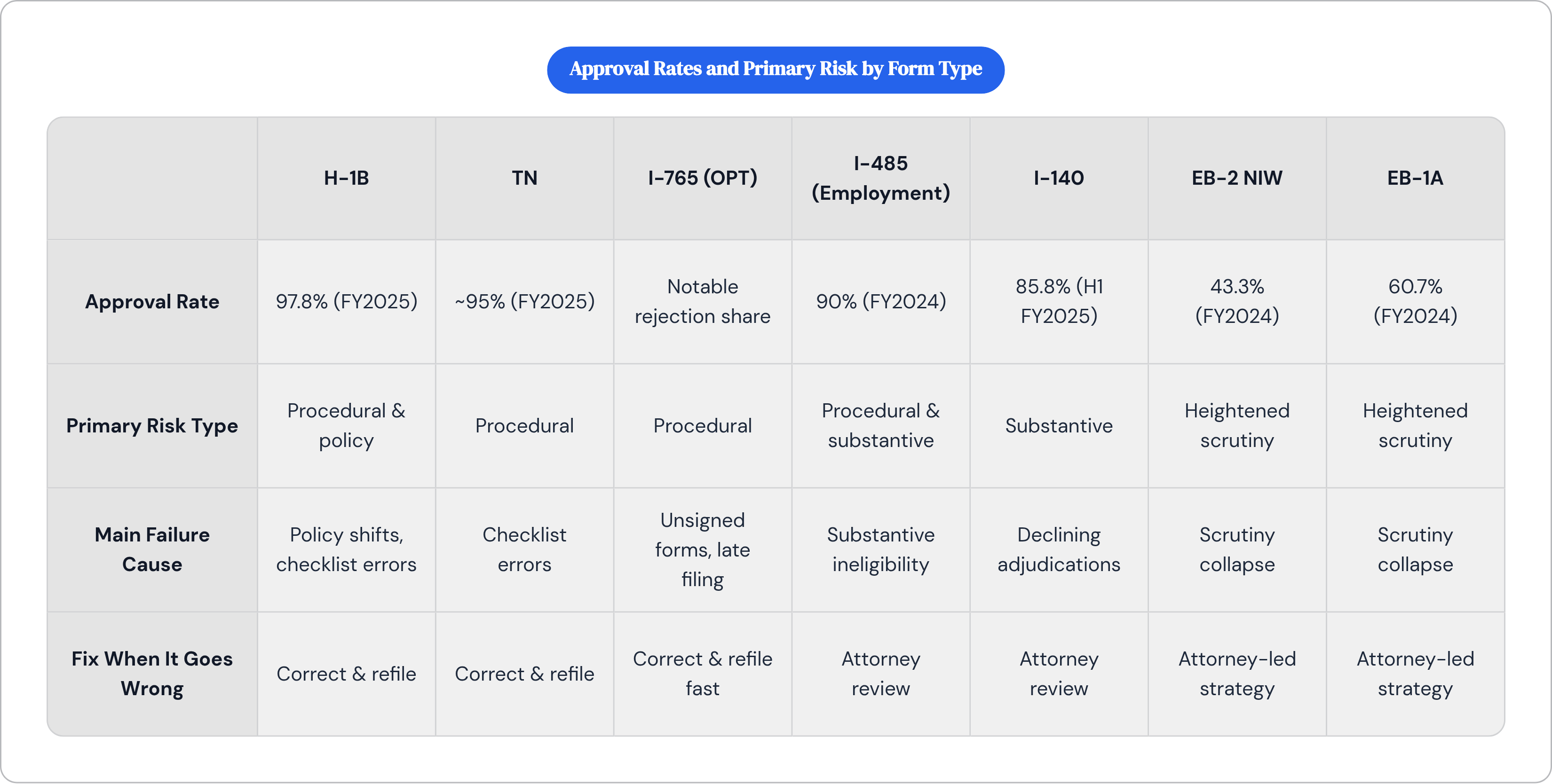
H-1B petitions carried a 97.8% approval rate in FY2025 across 214,040 adjudicated petitions, up from 97.7% in FY2024, per USCIS data. That fraction of a percent sounds trivial until you apply it to the volume, at which point it becomes thousands of rejected petitions. And it can move fast: denial rates hit 17% in Q1 FY2018 following the "Buy American, Hire American" executive order, up from 5.8% in Q3 FY2017. Policy shifts reprice the risk faster than most applicants track.
TN visa approvals came in at roughly 95% in FY2025, per USCIS data. Many Canadian and Mexican professionals assume the TN's relative simplicity insulates them from procedural missteps. It does not.
The OPT filing, Form I-765, is where procedural rejection risk concentrates most visibly. USCIS adjudicated hundreds of thousands of OPT applications in FY2025, and a notable share were rejected for reasons unrelated to academic record or employer offer, per USCIS data. The causes clustered predictably: incomplete forms, late filings, unsigned documents, employer classification errors. None of these required an adjudicator's judgment. They were checkboxes left unchecked.
Employment-based I-485 filings posted a 90% acceptance rate in FY2024, with 119,028 approvals out of 132,513 completed cases. The 13,485 employment-based denials represent a substantial number of disrupted outcomes, alongside approximately 47,496 family-based I-485 denials in the same year. I-140 approval rates slipped from 89% in FY2024 to 85.8% in the first half of FY2025, across declining total adjudications: 93,417 down to 83,060, per USCIS data.
The EB-2 NIW numbers tell a different story entirely, and it is not a comfortable one. Approval rates collapsed to 43.31% in FY2024, down from 79.99% in FY2023, against a historical baseline of 96 to 97% in FY2018 through FY2022. EB-1A tracked similarly, falling from 70.50% to 60.65% in one year. These are heightened scrutiny problems, not procedural rejection problems, and the distinction matters enormously for how a petitioner should respond.
That is the real taxonomy here. Forms with the highest procedural rejection risk, OPT and I-485, occupy a fundamentally different category from forms with the highest substantive denial risk, EB-2 NIW and EB-1A. A procedural rejection is a checklist problem. A substantive denial is an attorney problem. Knowing which one you are facing determines how you spend your time and money, and mistaking one for the other is its own kind of expensive.
The Specific Mistakes That Cause Procedural Rejections, and the Logic Behind Each One
These are not edge cases or cautionary tales about other people. They are the documented, recurring causes of rejected filings, and each one has a logic that is worth understanding rather than simply memorizing.
Missing or unsigned signature block. USCIS applies no human discretion here. An unsigned form is automatically returned before any review occurs. After July 2026, as discussed, the consequence can escalate from rejection to permanent denial without warning.
Incorrect filing fee. Fee discrepancies in either direction trigger rejection. USCIS has no mechanism to refund excess payments, and no mechanism to collect a shortfall. Fee schedules change, sometimes mid-year, sometimes mid-quarter. The only defensible practice is verifying the current fee on Form G-1055 the day you submit, not the day you started preparing the packet.
Outdated form edition. USCIS updates forms regularly. Filing on a superseded edition results in automatic rejection regardless of how carefully the form was completed. The edition date appears in the bottom-left corner of every USCIS form. Cross-referencing it against the current version on USCIS.gov takes about thirty seconds. A multi-month setback for thirty seconds of work is, objectively, a bad trade.
Wrong mailing address. USCIS routes filings to different lockbox facilities based on form type, the applicant's state of residence, and which carrier you used. USPS, FedEx, and UPS addresses frequently differ for the same form. A correctly completed, properly signed, accurately paid filing sent to the wrong address still gets rejected.
Blank fields instead of "N/A." Every field must be completed. A blank space reads as an incomplete form. Questions that do not apply require "N/A" or "None," not an empty box.
Missing pages. Every page of every form must be included, including pages that require no entries. USCIS will return the filing rather than call the petitioner to ask for the missing pages.
Date format errors. USCIS requires MM/DD/YYYY. International applicants accustomed to DD/MM/YYYY make this error with understandable frequency, and when it generates inconsistencies across fields or documents, it can flag the filing for additional scrutiny beyond a simple rejection.
Ink color and correction fluid. All forms require black ink. Correction fluid is not accepted because USCIS scanners cannot read through it, and a crossed-out answer may be equally unreadable. Either renders a form unprocessable.
Untranslated supporting documents. All foreign-language documents must include a certified English translation. USCIS does not translate on the petitioner's behalf.
Inconsistent name spelling. The name on the petition must match the passport, and it must match across every form and every supporting document. Inconsistencies trigger Requests for Evidence at minimum, rejection at worst.
A Pre-Submission Checklist Structured Around the Mistakes That Actually Cause Rejections
This is not a preparation guide. It assumes the form is complete and the reader is doing a final pass before sealing the envelope or clicking submit. The checklist is organized around the mistakes that cause actual rejections, not theoretical ones.
Form Integrity
Confirm the form edition matches the current version on USCIS.gov by checking the date in the bottom-left corner. Confirm every page is present and in order, including pages that require no entries. Confirm all fields are completed: no blanks, "N/A" or "None" wherever a question does not apply. Confirm all dates appear in MM/DD/YYYY format throughout. Confirm that name spelling is identical across all forms and all supporting documents, matching the passport exactly. Confirm the form is completed in black ink with no correction fluid.
Signatures
Confirm every required signature block is signed, checking the form instructions for everyone required to sign: petitioner, preparer, interpreter if applicable. After July 10, 2026, confirm signatures are original wet-ink, not digitally inserted or copied from another document. If submitting a scanned or faxed copy, confirm the original bore a valid wet-ink signature before it was reproduced.
Filing Fee
Verify the current fee on USCIS.gov on the day of submission, not the day preparation began. Confirm the check or money order is made payable to "U.S. Department of Homeland Security." Confirm the fee matches exactly: overpayment triggers rejection as surely as underpayment. If paying by check, confirm the account has sufficient funds; a returned check also triggers rejection.
Supporting Documents
Confirm all foreign-language documents have certified English translations attached. Confirm each translation includes a certification statement from the translator attesting to their competence and the accuracy of the translation. Confirm all required evidence items are included per the form's instructions and applicable USCIS Policy Manual guidance.
Mailing and Submission
Verify the correct USCIS filing address for the specific form, the applicant's state of residence, and the mail carrier being used: USPS, FedEx, and UPS addresses frequently differ for the same form. Use a service that provides tracking and delivery confirmation. Keep a complete copy of everything submitted, including the check, before sealing the envelope.
What to Do When a Rejection Notice Arrives, and How to Act Before the Clock Runs Out
Read the rejection notice carefully and completely before doing anything else. USCIS will specify the reason for rejection, and a fix is only possible if the applicant understands precisely what was wrong. Skimming it and assuming is how people make the same mistake twice.
Retrieve the returned package and verify it is complete. The original filing, all supporting documents, and the uncashed check or money order should all come back. If anything is missing, that needs to be identified immediately, not discovered later.
Correct only the identified error. Do not revise anything else. Changes to substantive information on a refile can introduce new inconsistencies that generate their own problems. Surgical fix, not a revision.
Before refiling, re-verify both the form edition and the current filing fee. If any time has passed between the original submission and the refile, USCIS may have updated either. Check both the day you refile, not the day before.
If the rejection affects immigration status or a pending deadline, an OPT end date, an H-1B cap window, a priority date, consult an immigration attorney before refiling. A rejected I-485 provides no status protection. A rejected OPT application leaves the applicant exposed during the gap. These situations call for legal guidance, not independent iteration.
If the rejection appears to be USCIS's error, gather evidence of the correct original submission and contact the agency directly or work through an attorney. USCIS makes scanning errors and misidentifies form versions. The petitioner is not automatically at fault, but bears the burden of proving it, which is its own particular frustration.
One point on timing that compounds everything else: with 11.3 million cases pending and completions declining, per the USCIS Fiscal Year 2024 Annual Report, a rejection and refile does not simply reset the clock. It sends the petitioner to the back of a longer queue than the one they left. The urgency to refile correctly the first time is compounded by the environment they are refiling into.
How the Job Search Feeds the Petition
The visa petition and the job search are not sequential. They are concurrent, and decisions made in one directly constrain the other in ways that most professionals do not map out until something goes wrong.
Consider what happened to one software engineer on OPT who accepted a contract role without verifying that the employer classification aligned with the I-765 filing. The petition came back rejected on a checkbox — not because of her qualifications, not because of any problem with the employer, but because the form had been treated as administrative background noise when it was actually load-bearing. The authorization clock kept running while the paperwork made its round trip. By the time she refiled correctly, weeks had evaporated from a finite window she could not recover. That scenario is not unusual. It is the ordinary consequence of treating the petition and the job search as two separate projects that happen to overlap.
An international professional navigating OPT or an H-1B transfer is not simply filing paperwork in the background of their career. The petition is the legal foundation of their professional presence in the country. An employer's willingness to sponsor, the timing of an offer, the decision to change jobs mid-petition, whether to take contract versus full-time employment: all of these feed directly into the petition's structure, eligibility, and timing requirements.
The job search determines the petition type. A full-time salaried offer structures an H-1B differently than a contract arrangement. The employer's size, location, and H-1B history affect documentation requirements. The occupation itself must satisfy the specialty occupation standard, and the more carefully that standard is examined, the more the job description itself must be constructed with adjudication in mind, not just hiring.
The job search also affects timing in ways that are unforgiving. H-1B cap petitions have a fixed filing window. OPT has a fixed duration with limited STEM extensions. A rejection during either window does not pause anything. The days spent waiting for the returned package, correcting the error, and refiling all count against a finite authorization period. Per the Office of the CIS Ombudsman, the U.S. immigration system rejects hundreds of thousands of petitions per year for reasons that have nothing to do with eligibility. Those are not abstractions. Those are professionals whose timelines compressed while their paperwork sat in transit.
When the petition and the job search are this tightly coupled, tracking employer sponsorship history, understanding what the petition actually requires, and monitoring application status are not peripheral activities. They are part of the same work, managed on the same timeline, with the same margin for error: which is to say, very little.