DIY USCIS Form Filing Tools for Individuals
Self-filers can navigate USCIS forms without attorneys if they choose wisely.

The immigration system processes cases at a scale most people don't register until they're in it — like stepping into an ocean and only then noticing there are no lifeguards. USCIS received 13.51 million cases in FY 2024. More than four in five naturalization applicants that year filed without an attorney. This is not a niche behavior; it is the dominant behavior. The tools available to self-filers have improved substantially, but understanding exactly what each tool does, what it cannot do, and where the legal line sits is what separates a clean filing from an expensive correction.
USCIS Just Told You What This Costs — And It's Not Getting Cheaper
USCIS published its first fee increase since 2016 in a January 2024 final rule, capping most individual-facing increases at roughly 26%, a figure indexed to CPI growth over that eight-year gap. The anchoring numbers are these: the I-130 petition for an alien relative runs $675 on paper, $625 online. The N-400 naturalization application is $760 standard, with a reduced fee of $380 available to applicants at or below 400% of the Federal Poverty Guidelines. An I-485 adjustment of status application costs $1,440 for most adults, $950 for children under 14 filing concurrently with a parent.
Employment-based petitions saw substantially steeper increases, though those are typically employer-borne: the H-1B petition rose 70% to $780, the L-1 rose 201% to $1,385, and a new $600 Asylum Program Fee now applies to employers filing certain I-129 or I-140 petitions. The H-1B cap registration fee jumped from $10 to $215 per registered beneficiary. These figures shape the broader cost psychology even for individual filers, because they establish a trajectory.
The compounding logic for individual filers is straightforward. When government fees alone reach into the hundreds of dollars, attorney fees on top of that, for a filing the filer is genuinely capable of completing accurately, represent a meaningful and avoidable expense. The 2024 fee rule also baked in a $50 discount for online filings versus paper, a small but deliberate nudge toward the e-filing portal. It is worth taking.
The myUSCIS Portal: Free, Functional, and Not a Substitute for Judgment
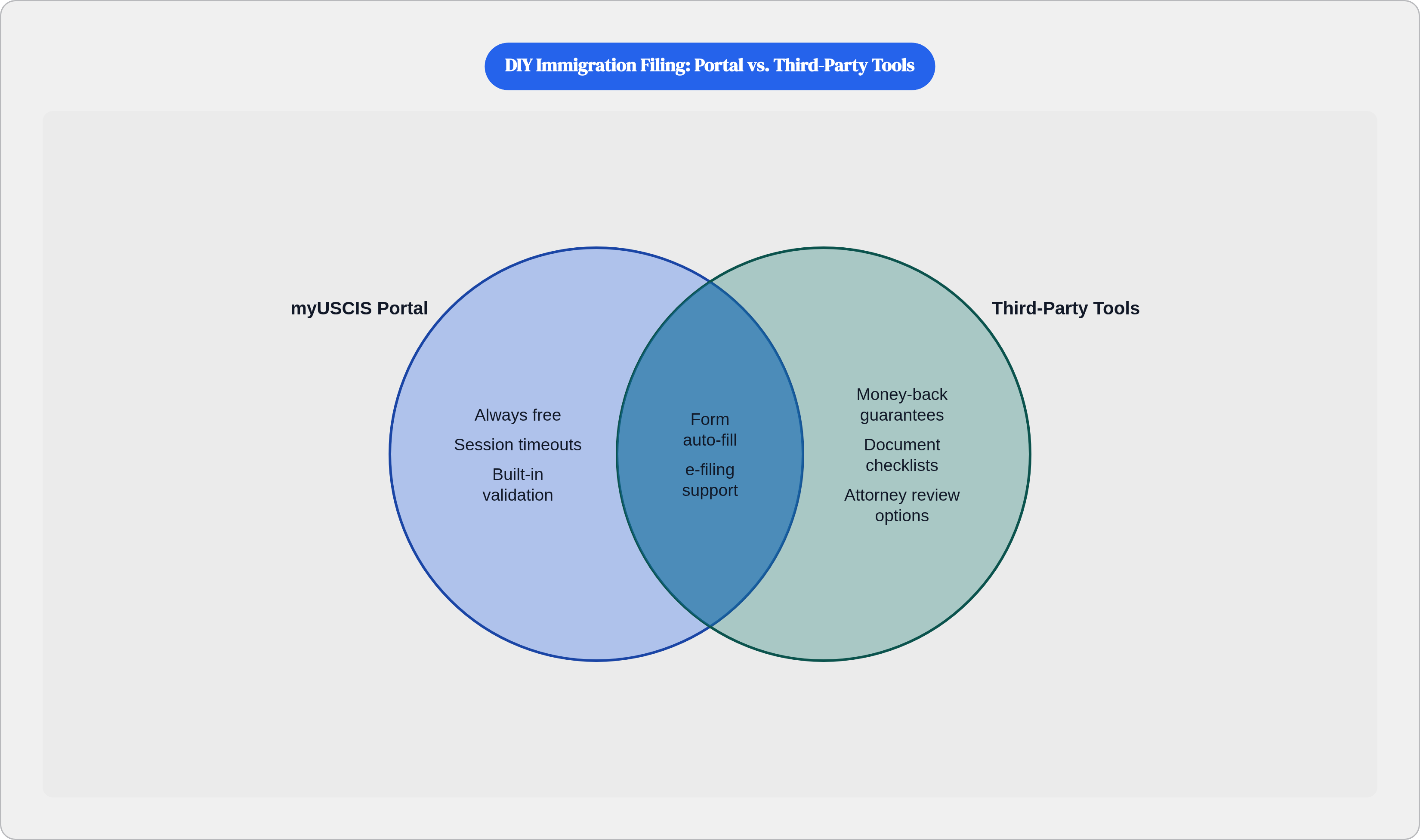
myUSCIS is USCIS's free, account-based portal. It offers personalized filing guidance, form preparation, fee payment, case tracking, and citizenship preparation resources. USCIS forms and online accounts are always free. The portal's most practical advantage is built-in validation: the system flags missing signatures, incomplete fields, and formatting errors before submission, which eliminates a category of mistakes that paper filers routinely make and fail to discover until a rejection notice arrives weeks later.
Forms currently available for online filing include the I-90 (Replace Permanent Resident Card), I-130, I-131, I-134, I-539, I-589, I-765 for certain eligibility categories, I-821, N-400, and several N-series naturalization-related forms. A noteworthy late-2025 addition, confirmed by practitioners, is the I-140 for EB-1A extraordinary ability and EB-2 National Interest Waiver self-petitioners, categories that previously required voluminous paper packages. The form list continues to expand; checking the current inventory before defaulting to paper is a sensible first step, not an afterthought.
The honest limitation of the portal is one that its own design cannot fix. The system automates submission for someone who already knows precisely what they are filing and why. It does not help a user determine whether to file, which category applies to their situation, or how to handle complications that disqualify a filing or trigger scrutiny. That is not a design flaw; it is a scope boundary. Knowing it exists is the entire point.
The Portal Will Sometimes Betray You — Here Is How to Not Let It
Users and practitioners have documented a consistent set of technical frustrations with the USCIS online system: unexpected session timeouts, data that fails to persist between sessions, and loss of entered information following system errors. Spending an hour on a form and losing all progress is not a hypothetical; it is a recurring complaint. Think of the portal as a car with excellent brakes but an unreliable engine — you want it for what it does well, but you shouldn't assume it will start every time.
The practical workarounds are unglamorous but effective. Use Chrome or Firefox; other browsers increase the probability of rendering issues. Clear cache regularly. Save progress frequently, and treat idle open sessions as a liability rather than a convenience. Perhaps most importantly: if a filing deadline is imminent and the portal is unresponsive, USCIS paper forms remain available and free. Having a paper fallback prepared is not paranoia; it is contingency planning for a system that, by its own track record, occasionally fails at inconvenient moments.
The central tension here is worth naming directly. The portal's validation features reduce content errors. Its technical instability introduces a different and worse risk: a missed deadline because the system failed on the day it mattered. These are not arguments against using the portal; they are arguments for entering it with accurate expectations rather than optimistic ones.
Third-Party DIY Tools: What They Automate, What They Guarantee, and What That Signals
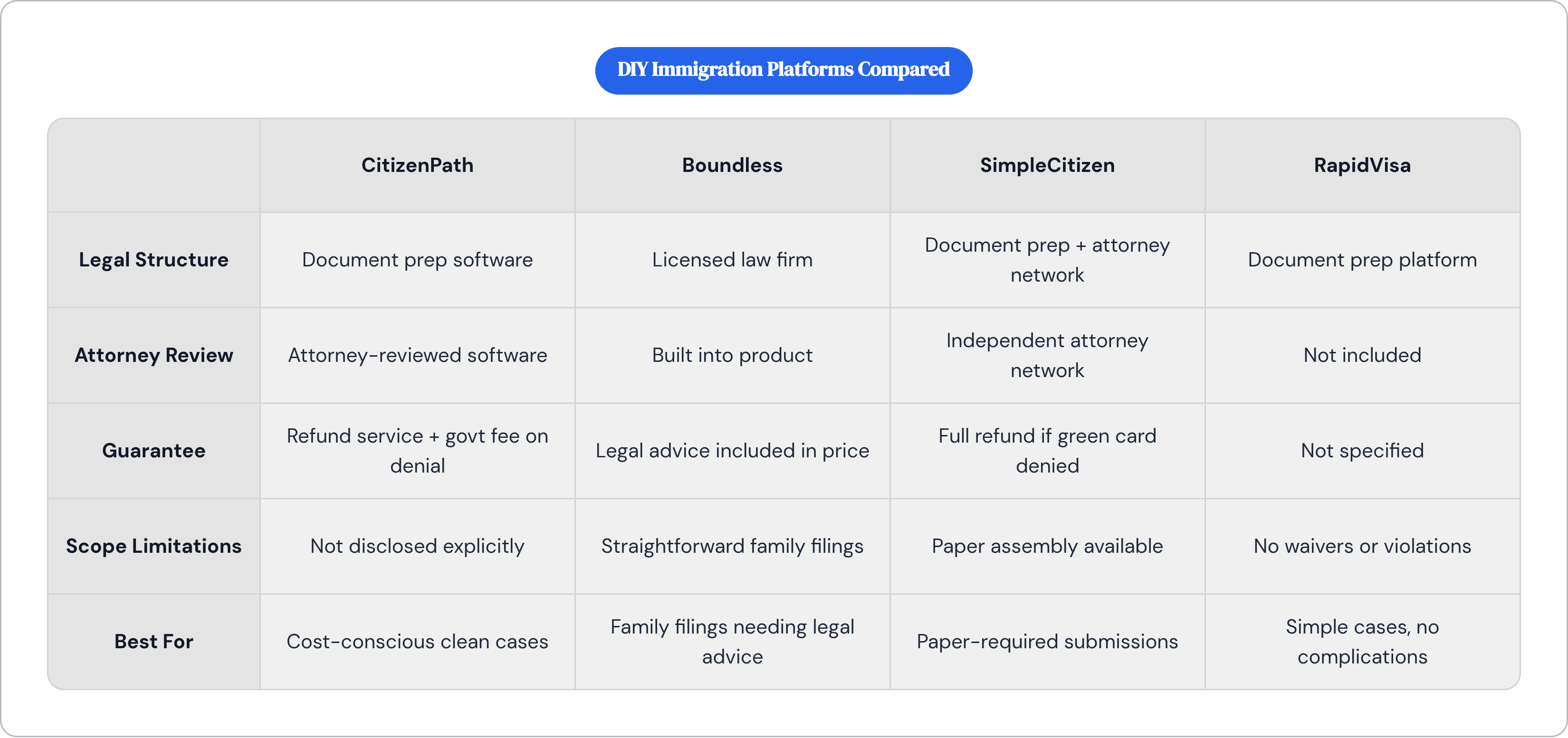
The shared model across third-party DIY tools is a questionnaire-driven intake that auto-populates USCIS forms, a document checklist tailored to the user's specific situation, filing instructions, and some mechanism for attorney review, either optional or built into the product. The differences between platforms are meaningful, and the guarantees they offer tell you something real about how they are structured.
CitizenPath
CitizenPath uses attorney-reviewed software to generate filing instructions and a document checklist specific to the user's circumstances. Its approval guarantee is substantive: if USCIS denies the application, CitizenPath refunds both the service fee and the USCIS filing fee. As of mid-2026, it has accumulated 1,538 Trustpilot reviews. The guarantee structure is the relevant signal; a company that eats the government filing fee on a denial has a direct financial incentive to decline cases it doesn't think will succeed.
Boundless Immigration
Boundless operates as a licensed law firm, Boundless Legal LLC, licensed by the Arizona Supreme Court. The legal review is not an add-on; it is the product. This structural distinction matters enormously: attorneys at Boundless can provide legal advice in the binding sense, which document-preparation platforms cannot. The platform holds 2,884 Trustpilot reviews at a 4.7 rating, with 91% five-star as of early 2025. For straightforward family-based filings where technology-enabled attorney review is sufficient, it is the most defensible lower-cost option, because the legal scaffolding is actually there.
SimpleCitizen
SimpleCitizen assembles forms through its software and then routes the completed package to an independent network of immigration attorneys for review. Notably, it can also print, assemble, and mail the physical application to the filer, which is useful for cases that still require paper submission. The platform has been operating since 2014 and offers a full money-back guarantee including government fees if a green card is not obtained. That is an unusually strong guarantee, and the longevity of the business is, in the absence of better data, at least one signal of operational competence.
RapidVisa
RapidVisa is a consumer-facing platform with more than 3,000 Trustpilot reviews at a 4.7 rating as of early 2025. Its scope boundary is explicit and worth quoting in spirit: the platform is not designed for cases involving inadmissibility, prior immigration violations, criminal history, or waivers. A platform that tells you what it cannot handle is being honest about its design; take that disclosure seriously.
The feature that unites all of these tools, beyond the specific mechanics, is the alignment of incentives. A money-back or approval guarantee means the platform bears some cost of failure. A paper form carries no such guarantee. That asymmetry is worth something, especially for a filer who is competent but not experienced.
Enterprise Immigration Software With Applicant Portals: What They Are and Why You Might Encounter Them
These platforms are sold primarily to law firms and employers, but individual applicants often interact with them because the applicant-facing intake portal is where the data actually enters the system. Understanding what these tools do helps filers engage accurately rather than treating the intake portal as an inscrutable black box.
eimmigration by Cerenade covers more than 300 immigration forms across USCIS, DOL, and DOS, with multilingual intake questionnaires in 13 languages that auto-populate across all relevant forms simultaneously. DocketWise uses a smart multilingual client intake questionnaire that auto-populates forms and assembles multiple forms and supporting documents into a single filing package for e-filing. Imagility applies OCR and NLP to extract data directly from passports, visas, I-94s, and supporting documents into form fields; it also generates draft support letters and case summaries using AI.
None of these platforms are positioned as fully self-service for individuals navigating complex filings alone. They assume a supervising professional is in the loop. If an employer or attorney has invited you into one of these portals, your job is to supply information accurately and completely; the strategic decisions are being made by someone else. That division of labor is intentional, and it is appropriate.
The Legal Line Is Not Ambiguous — But It Is Easy to Miss
The ABA Commission on Immigration has identified unauthorized practice of immigration law as a chronic, decades-long problem with severe consequences: financial loss, damaged applications, and outcomes as serious as deportation. The legal line is functionally clear even when it is practically easy to miss. An immigration consultant or document preparer may translate forms or assist a filer in completing information the filer has already decided to submit. Advising which form to use, whether the filer is eligible, or how to handle a prior complication constitutes legal advice and is unauthorized practice of law under the California Bar's framework and similar standards across other states.
In practice, this means the following. A platform that takes questionnaire responses and auto-populates forms is legitimate self-help software; you are providing the legal judgment, and the software is doing the mechanical assembly. A platform whose human staff tells you what category to file under or whether you qualify is providing legal advice; the relevant question is whether those staff are licensed attorneys or accredited representatives. Boundless can do what it does because it is structured as a licensed law firm. A document preparation service that tells you the same things is operating outside its legal authority, regardless of how its marketing describes the service.
The "notario" problem is a specific and well-documented consumer risk. In some communities, individuals operating as notarios or immigration consultants represent themselves as having legal authority they do not possess — promising to deliver a path through the system while holding a map they are not licensed to read. The ABA has explicitly flagged this pattern as a consumer protection failure. The vetting checklist is short: Are the people providing guidance licensed attorneys or accredited representatives? Does the service disclose precisely what it can and cannot do? Is there a written contract describing scope? Is the guarantee backed by a clear refund mechanism, or is it marketing language with no operational teeth?
The Cases Where DIY Works and the Cases Where It Doesn't
The N-400 naturalization application is the canonical DIY case. The FY 2024 attorney-representation figure of 17.8% confirms that most filers handle it alone, and for applicants who meet clear eligibility criteria, have a straightforward employment and residence history, and carry no criminal record, the form is well-defined enough that self-filing is realistic and appropriate. The same logic applies to I-90 card renewals with no change in status, I-130 family petitions for immediate relatives with no prior visa violations, and I-765 EAD renewals for OPT/CPT holders in standard circumstances. The near-4.8 million I-765 volume in FY 2024, a figure 36% higher than any prior year, is largely this population filing without counsel.
The calculus changes sharply when any of the following are present: prior removal, deportation, or unlawful presence, even brief; a criminal record of any kind, including minor offenses that carry immigration consequences that are non-obvious to lay filers; a case requiring a waiver of inadmissibility; a prior visa denial or revocation; or genuinely complex petition categories where the evidentiary standards are exacting. The EB-1A I-140 is now e-fileable, which is a real convenience. The extraordinary ability standard it requires is not simple, and the ability to submit the form electronically does not reduce the complexity of building an evidentiary record that USCIS will find persuasive.
The real cost of a filing error is not the service fee. It is the time lost, the re-filing cost, and for international students and professionals, the visa clock that does not pause while a rejected application is sorted out, which is why finding a verified sponsoring employer before that clock starts draining matters as much as the filing itself, a problem Migrate Mate, a subscription job board that connects international talent to confirmed US visa-sponsoring employers, is built around. The calibration here is not dramatic: use the tools described in this piece for what they handle well, which is a specific and meaningful category of filings. Treat any complication as a signal to consult a licensed attorney before submitting, not after a denial arrives.